On this page
- Luno review: our verdict
- Luno at a glance
- Is Luno legit? Licence and company
- Luno fees: instant buy vs the exchange
- Deposits and withdrawals in rand
- Worked example: R500 of bitcoin a month with Capitec Pay
- Coins, savings and staking
- Luno Pay
- App and account verification
- What to do if Luno asks for documents, delists a coin or SARS writes
- Concrete pros and cons
- Luno alternatives
- FAQ
This Luno review answers the question most South Africans actually have: is the country’s biggest crypto app still a good place to buy with rand? Mostly yes, provided you use the right screen. Luno is licensed by the FSCA (FSP 53314), EFT deposits and normal withdrawals cost nothing, and it reports 6.3 million South African users. The catch is price: the one-tap buy button on the portfolio screen costs 2% each way, while the same bitcoin bought on the Luno Exchange costs 0.60% or less.
Everything below comes from Luno’s own South African fee page (updated 12 November 2026), its licence page, the FSCA register and Luno’s public price data, all checked on 17 November 2026.
Luno review: our verdict
Luno suits a beginner who wants an FSCA-licensed app, free EFT deposits, Capitec Pay or Absa Pay as a way round bank blocks, and free QR payments at the till. It suits frequent traders less: at entry level its exchange taker fee of 0.60% on crypto/rand pairs is well above VALR’s 0.35%, and anyone who keeps tapping “Buy” on the portfolio screen pays 2% every time. If you want a far longer coin list than Luno’s 61, plus savings and staking, our top-rated exchange is the other route, with clear trade-offs: it is licensed in the US and UK rather than by the FSCA, it has no rand wallet, and South Africans fund it by sending crypto bought in rand on a local exchange such as Luno.
Want more than Luno's 61 coins?
Our top-rated exchange lists about 300 coins plus savings and staking. It is licensed in the US and UK, not by the FSCA, and you fund it with USDT or BTC bought in rand, for example on Luno.
Compare the top 10Our #1 pick · US FinCEN MSB · NMLS 1804170 · UK FCA reg. FRN 1007192
Luno at a glance
| What | Detail |
|---|---|
| Company | Luno (Pty) Ltd, reg. 2013/075107/07, operating since 2013 |
| FSCA licence | FSP 53314, Category I and II crypto assets, authorised 11 Apr 2024 |
| Office | Summit Place East, 29 Gogosoa St, Observatory, Cape Town |
| Coins | 61 for South African verified customers |
| Rand in | EFT free; instant deposit or Absa Pay 1.4%; Capitec Pay 1.25% under R1,000, R9 above; Apple Pay 2.5% |
| Rand out | Normal free (up to 2 business days); express R20, or R80 to non-RTC banks |
| Trading | Exchange 0.60% taker / 0.40% maker on crypto/ZAR at tier 1; portfolio buy or sell 2%; card 3.9% |
| Users | 6.3 million in South Africa (October 2025) |
Checked on 17 Nov 2026 against the FSCA register and Luno's South African fee page.
Is Luno legit? Licence and company
Yes. Luno (Pty) Ltd appears on the FSCA register as FSP 53314, authorised on 11 April 2024 for Category I (advice and intermediary services) and Category II (discretionary management) crypto asset services. Luno says it was the first dedicated crypto asset service provider to get its licence. Its licence page also lists a registered credit provider number (NCRCP22123), registration as a third-party payment provider, FIC registration AI/130605/00024 and a juristic-representative arrangement with Black Onyx CurrencyHub (FSP 50850) for derivatives.
The company has run since 2013, has its South African office in Observatory, Cape Town, and describes itself as an operating subsidiary of Digital Currency Group. Every month the audit firm Moore attests to Luno’s proof of reserves using a Merkle tree, and you can check that your own balance is included, though only on the website, not in the app.
What the licence buys you is conduct rules and a complaint route to the FAIS Ombud. It is not deposit insurance and it does nothing when the bitcoin price falls. If you want to see the entry yourself, our guide on how to check an FSCA licence shows the search screen step by step.
Luno fees: instant buy vs the exchange
Luno gives you two ways to buy, and the price gap between them is the single most important thing in this review. The portfolio screen’s Buy button is an instant buy: Luno fills the order at a quoted price and charges 2%. The Luno Exchange is an order book where you trade with other users and pay a maker or taker fee that falls as your 30-day volume rises.
| Action | Fee at entry level | Notes |
|---|---|---|
| Instant buy or sell (portfolio screen) | 2% | Swapping rand for ZARU is free; ZARSC is free to buy, 3% to sell |
| Card instant buy | 3.9% | Minimum R15, maximum R30,000 per transaction |
| Exchange taker, crypto/ZAR | 0.60% | 0.50% from R20,000 of 30-day volume |
| Exchange maker, crypto/ZAR | 0.40% | 0.30% at tier 2 |
| Exchange USDT/ZAR and USDC/ZAR | 0.20% taker, −0.01% maker | Makers earn a tiny rebate |
| Crypto sends | Dynamic, shown before you confirm | XRP fixed at 0.03% |
Luno fees and limits in South Africa, fee page updated 12 Nov 2026.
What R5,000 in, a bitcoin buy and R5,000 out costs
Here is the same round trip done two ways: deposit R5,000, buy bitcoin, sell it again and withdraw. To keep the sums simple, each fee is worked out on R5,000 and the price is assumed not to move.
| Step | Exchange route | Cost | Portfolio-screen route | Cost |
|---|---|---|---|---|
| Rand in | EFT | R0 | Instant deposit 1.4% | R70 |
| Buy BTC | Taker order 0.60% | R30 | Instant buy 2% | R100 |
| Sell BTC | Taker order 0.60% | R30 | Instant sell 2% | R100 |
| Rand out | Normal withdrawal | R0 | Express withdrawal | R20 |
| Total | R60 (1.2%) | R290 (5.8%) |
Placing limit orders as a maker drops the exchange route to about R40. A market order also crosses the spread: at 07:41 UTC on 17 November 2026 Luno’s BTC/ZAR book showed R1,101,167 to buy from and R1,102,797 to sell into, a gap of about 0.15%. Paying by card from the start (3.9%, or R195 on R5,000) is the most expensive way in.
Deposits and withdrawals in rand
EFT deposits are free with no limit. Capitec has blocked app EFTs to crypto exchanges since October 2024, so Capitec clients use Capitec Pay: 1.25% on deposits under R1,000 and a flat R9 above that, which is only 0.18% on R5,000. Absa Pay and Luno’s instant deposit cost 1.4% up to R100,000, and Apple Pay costs 2.5% (R50 to R30,000). Discovery Bank clients can also move rand into a linked Luno wallet from the Discovery app, a link that has run since December 2025.
Two warnings. Cash deposits cost R20 plus 5%, and Luno’s terms prohibit them: an account that receives more than one cash deposit may be suspended indefinitely. And despite what some sites claim, Luno does not list PayShap as a deposit method; we found no exchange that does. Our guide to rand deposits bank by bank compares every route.
Withdrawals go only to a bank account in your name. Normal ones are free and land up to two business days after Luno processes them, usually sooner with Standard Bank. Express withdrawals arrive the same day for R20 if your bank is on real-time clearing (RTC), or R80 if it is not. How much you can move depends on verification: Level 1 is capped at R15,000 in and out over the life of the account, Level 2 at R50,000 a month, and fully verified accounts have no limit. Selling first and then withdrawing is covered step by step in how to sell crypto for rand.
Worked example: R500 of bitcoin a month with Capitec Pay
Take an illustrative case: a Capitec client in Soweto who wants to put R500 into bitcoin every payday. Capitec’s app won’t send an EFT to Luno, so Capitec Pay is the way in. Linking the two costs a once-off R1, and Luno only allows it once your account is verified to Level 2 with a South African ID. After that, each deposit costs 1.25% up to R1,000 and R9 above that.
Done the easy way, every month costs R6.25 for the Capitec Pay deposit plus R10 for a 2% instant buy: R16.25, or R195 over a year. Place the same R500 order on the exchange screen instead and the buy costs R3 at the 0.60% taker fee, so the month comes to R9.25 and the year to R111. The bigger saving comes from depositing less often. Move R1,500 across once every three months and you pay the flat R9 four times a year (R36); twelve exchange buys of R500 add another R36. That is R72 a year instead of R195 for the same bitcoin. Use a limit order and pay the 0.40% maker fee, and the trading part drops from R36 to R24.
Small orders work fine on the exchange: Luno’s minimum BTC/ZAR order is 0.00001 BTC, about R11 on 17 November 2026. What no fee trick fixes is the price: buying a fixed amount every month evens out your entry price, but it doesn’t stop bitcoin falling.
Coins, savings and staking
Luno lists 61 assets for South African verified customers. Beyond bitcoin, Ether, XRP, Solana, USDT and USDC you’ll find gold-backed tokens (PAXG and XAUT) and two rand coins, ZARU and ZARSC. Depth is concentrated in a few pairs: in the 24 hours to 08:10 UTC on 17 November 2026, Luno’s BTC/ZAR market traded 16.95 BTC (about R18.7 million), the highest BTC/ZAR volume of the local books we checked, and USDT/ZAR about R16.7 million.
Staking pays you part of a proof-of-stake network’s rewards, and Luno keeps a service fee from each payout: 20% for ADA, 30% for ETH, 35% for SOL, DOT, NEAR and AVAX, and 40% for ATOM. Bundles cost 1% to buy, 1% to sell and 2% a year for rebalancing, charged quarterly. Tokenised stocks and ETFs cost 1% per trade, with a R20 minimum. We found no interest-paying savings wallet on Luno’s South African fee page, so staking is the only earning product it lists.
Luno Pay
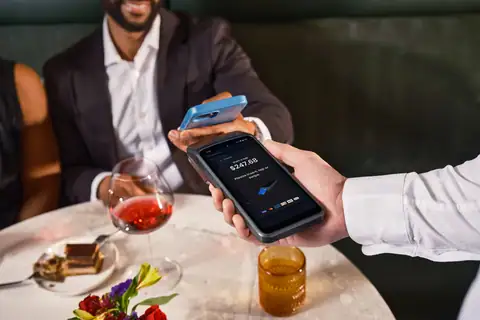
Luno Pay lets you scan a QR code at the till and pay from your rand or crypto balance. It is free and works from R1 to R100,000 per payment. Luno says it is accepted at nearly a million merchants; by October 2025 it had processed more than 50,000 payments worth over R30 million. Luno wallets also work with MoneyBadger, which runs at Pick n Pay tills in more than 1,500 stores.

One practical point: if you pay from a crypto balance rather than your rand wallet, SARS sees a disposal, just as if you had sold the coins. Small coffees add up on a tax return. Our guide to paying with crypto covers the other wallets and where they work.
App and account verification
Opening an account takes about 15 minutes if your documents are at hand.
-
Sign up and switch on 2FA
Register with your email and phone number, then switch on app-based two-factor authentication before you deposit anything.
-
Verify your identity
Luno’s FICA (identity) checks start with your ID and a selfie. Each step up raises your limits, from R15,000 over the life of a Level 1 account to no limit once fully verified.
-
Fund by EFT or a bank Pay button
Use EFT if you can wait; Capitec Pay or Absa Pay if you can’t.
-
Buy on the exchange, then test a withdrawal
Switch to the Exchange tab for your first real order, then withdraw a small amount back to your bank to make sure the details work.
Sending crypto out of Luno now comes with questions. Since 30 April 2025 South African exchanges must collect sender and recipient details, and the FIC’s guidance of 30 March 2026 applies that to every transfer, including to your own wallet. Have the recipient’s name and platform ready; our crypto travel rule guide explains each field.
What to do if Luno asks for documents, delists a coin or SARS writes
Luno asks where your money comes from
Luno has to keep checking who its customers are, so some get an email headed “Important: Please verify your information”. Before you upload anything, check that the same message appears under Notifications in the Luno app or on the website: an emailed link asking for your ID and bank statements is exactly what a phishing scam looks like.
Luno usually asks for the last three months’ bank statements for every account you’ve deposited from, a recent proof of address (not needed if it matches your bank statements), proof of your source of funds and a photo of you holding your ID. Source of funds can be payslips, an employment contract, a property or business sale agreement, a tax return statement or an inheritance letter; if the money came from crypto bought elsewhere, an official statement from that platform. Send full PDFs with the bank’s header, no older than three months: Luno rejects banking-app screenshots and anything with details blacked out, and each rejection adds a delay. Answer promptly to keep the account working.
A coin you hold is delisted
Luno removes coins in stages and warns holders by email or app notification. Loopring (LRC) shows how it works for South African customers: deposits stopped on 28 September 2026, its order books closed on 8 October, holders could sell or send their coins until 2 November, and on 11 November 2026 any LRC left in an account was converted to rand at the market rate. That automatic conversion is a disposal, so it goes on your tax return like any other sale.
A send to another exchange won’t go through
Luno sends crypto only to platforms on its approved travel-rule list, which for South African customers includes VALR, AltCoinTrader, Ovex, Bybit, Kraken, OKX and CEX.IO. You answer the ownership questions once per new address.
SARS writes to you about crypto
Assume SARS can see your Luno account. In June 2021 SARS used its information-gathering powers to ask Luno, VALR and AltCoinTrader for customer data. Since 1 March 2026 Luno has checked the tax residency of new South African customers, and it must report their crypto activity and year-end balances to SARS under the Crypto-Asset Reporting Framework and the Common Reporting Standard. The first CARF report, covering 1 March 2026 to 28 February 2027, is due at SARS by 31 May 2027.
SARS’s crypto letters ask you to respond within 21 days of the date on the letter, so pull your records first. On the Luno website (not the app), open Portfolio, choose a wallet, scroll to the bottom and select Download statement, then pick the dates and PDF or CSV. Each wallet has its own statement, so repeat it for your rand wallet and every coin you’ve held. Our crypto tax guide explains how to answer the letter and when voluntary disclosure is still open.
Concrete pros and cons
+Works in your favour
- FSCA licence FSP 53314, authorised 11 Apr 2024 for Category I and II
- Free EFT deposits with no limit, and free normal withdrawals with no monthly cap
- Capitec Pay costs R9 on deposits over R1,000, a way round Capitec's block on app EFTs
- Monthly proof-of-reserves attestation by Moore, with a Merkle-tree self-check on the web
- Luno Pay QR payments are free from R1 to R100,000
- Highest BTC/ZAR volume of the local books we checked: 16.95 BTC in 24h (17 Nov 2026)
−Works against you
- Instant buy and sell on the portfolio screen cost 2% each way; card buys 3.9%
- Exchange taker fee of 0.60% on crypto/rand pairs at tier 1, against 0.35% on VALR
- 61 coins, against 149 spot assets on VALR
- Staking keeps 20–40% of your rewards (ETH 30%, SOL 35%, ATOM 40%)
- Express withdrawals cost R20, or R80 if your bank is not on RTC
- Proof-of-reserves self-check works on the website only, not in the app

LunoNo. 3
Luno (Pty) Ltd · Observatory, Cape Town · since 2013
- Licence
- FSCA FSP 53314 (authorised 11 Apr 2024)
- Rand in
- Free EFT; instant / Absa Pay 1.4%; Capitec Pay R9 over R1,000
- Rand out
- Free normal (2 business days); express R20
- Trading fee
- Taker 0.60% / maker 0.40% (crypto/ZAR, tier 1); instant buy 2%
Best for: Beginners and paying in shops with Luno Pay · 61 assets
What you get
- +Free EFT deposits and free normal withdrawals
- +Capitec Pay and Absa Pay deposits work around Capitec’s exchange-transfer block
- +Monthly proof-of-reserves attestation by Moore
- +Luno Pay: free QR payments, R1 to R100,000
Watch out for
- −Instant buy from the portfolio screen costs 2%; card buys 3.9%
- −Exchange taker fee 0.60% at tier 1 is high next to VALR
- −Staking service fee of 20–40% of rewards
Luno alternatives
If fees matter more than the app, VALR is the obvious comparison: 0.18% maker and 0.35% taker on rand pairs at entry level, 30 free rand withdrawals a month and by far the deepest rand order book. Our VALR review goes through it in the same detail. If you want about 300 coins plus savings and staking, our #1-rated exchange is CEX.IO; it is licensed in the US and UK but has no FSCA licence and no rand wallet, and South African cards may not fund it under the Reserve Bank’s rules, so you send crypto bought in rand instead. Our CEX.IO review spells out the route.
For a head-to-head on fees, deposits and licences, see Luno vs VALR vs Binance, and for the full ranked list our page on the best crypto exchanges in South Africa. If you live in the Mother City, our Cape Town crypto guide covers Luno’s Observatory base and the other local firms.
That is the Luno review in one line: a licensed rand on-ramp with free EFT in and out, cheap if you trade on the exchange screen and expensive if you tap Buy on the portfolio screen.
Want a second account for coins Luno doesn't list?
Many South Africans keep Luno for EFT and rand withdrawals, and send USDT or BTC to a second platform for a wider coin list. Start small and test a transfer first.
Luno vs VALR vs BinanceOur #1 pick · US FinCEN MSB · NMLS 1804170 · UK FCA reg. FRN 1007192
Frequently asked questions
Is Luno legit and licensed?
How much does Luno charge?
How long does a Luno withdrawal take?
Is Luno safe after the travel rule changes?
Can I use Luno Pay at shops?
Is Luno cheaper than VALR?
Does Luno share my information with SARS?
Sources we checked
- ↗SARB — Currency and Exchanges Manual for Authorised Dealers (B.16(E)(v))
- ↗Luno — Fees and limits in South Africa (updated 12 Nov 2026)
- ↗Luno — Licences and registrations
- ↗Luno — Proof of reserves
- ↗FSCA — Financial services provider search
- ↗FIC — PCC 61: travel rule for crypto asset service providers (30 Mar 2026)
- ↗Luno — public ticker API (24h volumes, 17 Nov 2026)
- ↗FF News — Luno passes 6.3 million South African users (Oct 2025)
- ↗Discovery Bank — Luno crypto in the banking app
- ↗Luno — How do I deposit using Capitec Pay? (updated 12 Nov 2026)
- ↗Luno — exchange market rules API (BTC/ZAR minimum order, 17 Nov 2026)
- ↗Luno — I've been asked to provide more information about myself (updated 17 Nov 2026)
- ↗Luno — Which documents can I submit to verify my source of funds?
- ↗Luno — Notice of regional asset delistings (October 2026)
- ↗Luno — Approved CASPs in South Africa (travel rule)
- ↗Luno — Why does Luno need my tax details? (CARF and CRS)
- ↗Luno — How do I download my wallet statement?
- ↗SARS — Crypto-Asset Reporting Framework (CARF)
- ↗TechCentral — SARS asks crypto exchanges for customer information (1 Jun 2021)
Risk note: crypto prices can fall sharply and you can lose all the money you put in. This page is general information, not financial or tax advice. Fees, limits and licences change; check them on the provider’s site and the FSCA register before you act.